
AMOS Expertise · Technical Data Services
PMS & CMMS
Database Development
Turn vessel and offshore technical documentation into connected equipment, maintenance and spare parts records, with a consistent fleet perspective.
Discuss Your Database RequirementsExplore the relationships
One equipment record.
A connected technical picture.
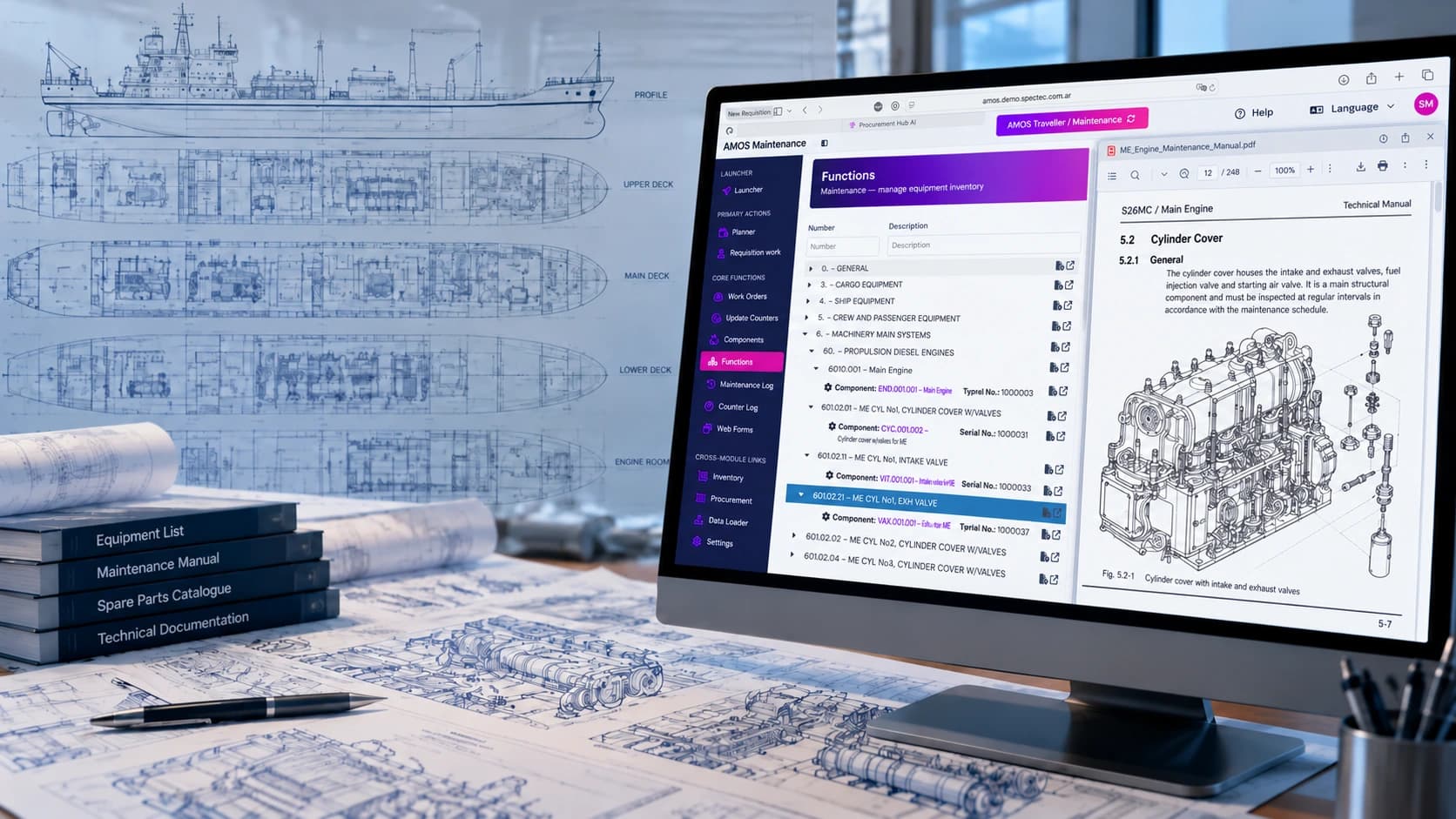
Explore how equipment, maintenance, spare parts and technical sources relate to each other.
Identify the installed equipment
The equipment hierarchy gives each maintainable item a place in the asset structure. Applicable manuals and drawings provide the technical context.
Equipment → Applicable documentation
An engineering task before it becomes a system record
A chief engineer needs to find the right maintenance task for the equipment on board. A technical superintendent needs to understand what that record represents when reviewing the fleet. Both depend on technical information that reflects the installed machinery and the operator's maintenance requirements.
SpecTec Middle East develops planned maintenance system (PMS) and computerised maintenance management system (CMMS) databases for vessels, rigs and platforms. Our AMOS expertise brings the technical documentation and the intended maintenance workflow into the same conversation, from identifying equipment to organising its jobs and spare parts.
The scope starts with the asset and its available records. We agree what will be built, which source information will support it and who will resolve technical questions before the database is accepted.
Start with the documents that describe the asset
OEM operating and maintenance manuals, spare parts books, general arrangement plans, equipment drawings and machinery lists provide different parts of the picture. A drawing can establish where equipment belongs; the applicable manual explains the maintenance requirements and parts references for that equipment.
Documents need to be read against the asset they describe. Model differences, document revisions and conflicting identifiers can change which instructions apply. Missing information is raised with the customer for clarification. Where practicable, we assist with identifying appropriate supporting documentation; unavailable technical details are not filled with assumptions.
Connect the equipment, the work and the parts
Equipment records with technical context
Organise systems, equipment and maintainable components into a hierarchy that users can navigate. Identification and technical attributes are drawn from the applicable sources, keeping equipment relationships visible alongside the information needed to recognise each item.
Maintenance jobs tied to their sources
Prepare job descriptions and procedures against the relevant equipment and documented maintenance requirements. Calendar and running-hour intervals are represented where supported by the source information and the customer's approved maintenance policy. Technical owners review ambiguities rather than treating an uncertain interval as an established requirement.
Parts catalogues linked to installed equipment
Organise spare parts descriptions, maker references, part numbers and drawing references around the equipment they support. An equipment-linked catalogue helps users move from an equipment record to its relevant parts information. Similar descriptions alone do not establish that two parts are interchangeable. Opening stock quantities are a separate input and require an agreed verification basis.
Review the technical content and the relationships
Quality review considers whether a record matches its source and whether it belongs with the correct equipment. It also considers incomplete fields, conflicting references, duplicate candidates and the connections between equipment, jobs and parts.
Duplicate candidates need context. Two similar pumps may be separate installed units; two parts with similar names may have different specifications. Questions that cannot be settled from the documentation are returned to the responsible technical owner. The agreed scope should identify how unresolved exceptions affect acceptance.
Prepare the content for the AMOS environment
An AMOS database build needs to fit the customer's equipment structure, maintenance practices and installed system configuration. Preparation therefore considers the target record requirements alongside the technical content. AMOS is a core area of STME expertise; another PMS or CMMS requires an assessment of its requirements.
Keep a fleet view without losing the vessel detail
Fleet harmonisation helps shore teams interpret technical information consistently across assets. Common terminology and record expectations need to coexist with the equipment actually installed on each vessel, rig or platform. A common description must not conceal a different model, maintenance requirement or parts reference.
Choose the service around the starting information
New PMS database construction starts with technical documentation and builds the equipment, maintenance and parts content needed for an agreed maintenance-system scope. Reconstructing an incomplete technical database may also require this engineering work.
Legacy migration and data management start with existing records. The work centres on assessing, cleansing, converting and transferring those records, or maintaining their quality as operations change. Existing history, attachments and record relationships require an explicit migration scope; a new technical database build does not automatically include them.
Some engagements need both. For example, an existing database may be migrated while missing equipment and jobs are developed from manuals. Agree the boundary and acceptance requirements for each workstream. Operational record preparation and entry, including crew and quality records, sit within the separate Data Services offering.
Additional technical requirements
Where agreed, the build can include class-survey-related jobs and customer-specific work-order reporting formats, such as insulation-resistance or crankshaft-deflection records. These requirements need asset-specific references and review. Recording class-related work does not establish class approval or a live connection to a class authority.
Planning your database build
What is PMS database development?
It is the creation and structuring of the equipment, maintenance and spare parts records used by a planned maintenance system. For ships and vessels, the build uses asset-specific documentation to connect installed equipment with the jobs and information needed to maintain it.
What is the difference between PMS and CMMS database development?
PMS emphasises planned maintenance and is commonly used terminology in shipping. CMMS is the broader maintenance-management system term used in contexts including rigs and platforms. In either case, the database build needs an agreed asset structure, usable maintenance records and links to relevant technical and spare parts information.
Is this the same as data entry or software database development?
The deliverable is technical content for a maintenance system: equipment structures, maintenance tasks, intervals and parts relationships. Engineering interpretation of the source documentation is central to the work. Operational record entry, such as crew and quality data, is covered by our separate Data Services offering.
Which maintenance system is the database prepared for?
AMOS is a core area of STME expertise. Requirements for another PMS or CMMS must be assessed against its data structure and import requirements; compatibility with every platform is not assumed.
Start with your asset
Discuss your database requirements
Tell us about your vessels, rigs or platforms, the AMOS environment or other target system, and the documentation or existing records available. We can discuss the engineering scope, review responsibilities and information needed to define the work.